
India has strongly criticized the US and EU for their 'unjustified and unreasonable' targeting of New Delhi for its procurement of Russian crude oil, pointing out their own continued trade relations with Russia.
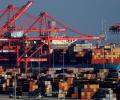
An Indian official team is likely to visit Washington next week to iron out differences on certain issues before formally launching negotiations for the proposed India-US bilateral trade agreement (BTA), an official said. The visit, which comes within weeks of a high-level US team visiting India, indicates that the talks for the BTA are gaining momentum.

The US-China rapprochement, however tenuous, is not without implications for India. Both China and Pakistan have become closer to the US, notes Ambassador T P Sreenivasan.

External Affairs Minister S Jaishankar conveyed a strong message to his Polish counterpart Radoslaw Sikorski regarding terrorism and the Ukraine conflict, emphasizing the need for zero-tolerance towards terrorism and criticizing the selective targeting of India.

For India, much is at stake: Crucial energy supplies traversing the Strait of Hormuz, the fate of its 10 million citizens living and working in West Asia -- who send generous remittances home -- and its major trade links with the region.

The official also advised all the trade partners to abide by the trade deals. The new 10 percent global tariff is part of Trump's protectionist trade agenda, aimed at addressing balance-of-payments issues and unfair trade practices.
Senior officials of India and the US will begin three-day talks on the proposed bilateral trade agreement in New Delhi on Wednesday amid threats of reciprocal tariffs from the Trump-administration, an official said. To formally start the negotiations on the pact, Assistant US Trade Representative for South and Central Asia Brendan Lynch, along with a team of officials, is in New Delhi.
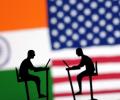
India and the visiting US officials have decided to hold a wrap-up session on Saturday morning to conclude the three-day talks on the proposed bilateral trade agreement, government sources said. They said the discussions are at a "very" early stage.

The proposed trade deal with the 27-nation European Union (EU) is expected to provide zero-duty access to the $95 billion European market for Indian textile and apparel manufacturers. Currently, India's share of the European market is just 6 per cent, or $5.5 billion.

The Congress MP said he had been "troubled" by the US tariff regime from the very beginning, adding that India was already at a disadvantage compared to its regional competitors.

Ahead of trade talks between Indian and United States officials in Delhi, White House trade advisor Peter Navarro said India, which has the 'highest tariffs' of any major country, is 'coming to the table'.

With US President Donald Trump "temporarily suspending" country-specific reciprocal tariffs until July 9, India sees the three-month window as an opportunity to renew its push for a proposed bilateral trade agreement (BTA) with the US and expedite finalisation of the first tranche of the trade deal.
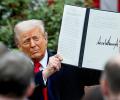
'April 9 announcement of slapping a 125% tariff on Chinese goods has brought the focus back to China, making this new phase feel like a repeat of the original conflict.'
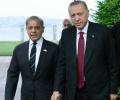
Pakistan Prime Minister Shehbaz Sharif met with Turkish President Recep Tayyip Erdogan to review bilateral relations and reaffirm their commitment to strengthening their strategic partnership. The two leaders discussed joint ventures and enhanced bilateral investment in key sectors, aiming to achieve a $5 billion annual bilateral trade target. They also expressed gratitude for mutual support during recent tensions with India. The meeting was described as "warm and most cordial," highlighting the deep-rooted historical ties between Pakistan and Turkey.

New Delhi will substantially reduce tariffs on industrial and agricultural goods while continuing to protect sensitive sectors. Tariffs on some agricultural products that are not traditionally considered sensitive will be brought down to zero, while in the case of relatively sensitive items, duties will be reduced in a graded manner and quotas will be imposed.
Domestic exporters on Monday expressed concerns over the crisis in Bangladesh and said the developments in the neighbouring country would have implications on bilateral trade. However, exporters expect that the situation may normalise soon. According to exporters, they are already facing disruptions in exports to Bangladesh due to a shortage of foreign exchange in that country.

Since May 10, when Trump announced on social media that India and Pakistan had agreed to a "full and immediate" ceasefire after a "long night" of talks mediated by Washington, he has repeated his claim over 70 times that he ended the conflict between India and Pakistan.
Prime Minister Narendra Modi is likely to address the UN General Assembly in September. The session will address global conflicts and trade negotiations between the US and India.

'The West Asia or the Gulf crisis has shown that what we develop as national infrastructure when things are not as bad as they could be, we forget to plan for adversities.'

The Indian embassy in Tehran has earlier stated that it is facilitating the safe movement of nationals who wish to leave Iran.
Deloitte on Thursday projected economic growth at 6.5-6.7 per cent for the current fiscal, as tax incentives provided in the Budget are expected to push domestic demand amid an uncertain global trade environment. Deloitte estimated India's GDP growth at 6.3-6.5 per cent for FY25 and said that the economic outlook for FY26 hinges on a delicate balance between evolving trade relations and government efforts to boost domestic consumer demand.
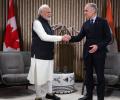
For Canada, important steps towards containing domestic elements that fuel pro-Khalistan sentiments can go a long way in signalling trust positively with regard to security and sovereignty, point out Harsh V Pant and Vivek Mishra.

Iran is fighting a different war: Older, slower, and in some ways more dangerous. Iran doesn't need to shoot down an F/A-18. It only needs to make the Strait of Hormuz feel dangerous long enough for insurance markets, shipping companies, and oil futures traders to do the rest. Prem Panicker continues his must-read daily blog on the war in the Middle East.
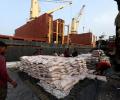
The government on Wednesday approved two schemes worth Rs 45,000 crore to help exporters tide over the impact of high tariffs imposed by the US on Indian shipments.
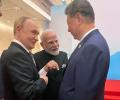
The relations between New Delhi and Washington are on a downturn after Trump doubled tariffs on Indian goods to a whopping 50 per cent, including a 25 per cent additional duties for India's purchase of Russian crude oil.
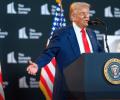
He added that India sells to the US, its biggest "client", "massive" amounts of goods, "but we sell them very little - Until now a totally one sided relationship, and it has been for many decades."
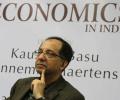
Former World Bank Chief Economist Kaushik Basu on Thursday said the US economic policy towards India has taken an unfortunate turn, noting that President Donald Trump's harsh stance against New Delhi appears baffling. US President Donald Trump on Wednesday announced a 25 per cent tariff on Indian goods from August 1, amid signs of a stalemate in the ongoing bilateral trade negotiations between the two countries.
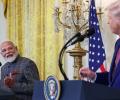
Of Trump's reciprocal tariffs and trade deals

'...but I would not like to put a timeline to it'

The United States action of levying 25 per cent additional tariff on Indian goods is 'unfair, unjustified and unreasonable', India said on Wednesday in a firm reaction, signalling increasing tensions between the two strategic partners over New Delhi's energy ties with Moscow.
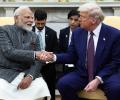
Prime Minister Narendra Modi on Saturday 'deeply' appreciated United States President Donald Trump's 'positive assessment' of the India-US partnership after the American leader hailed the 'special' relationship between the two nations -- remarks seen as an attempt to check the downturn in the ties.
India's proposal to impose retaliatory import duty on certain US products in response to American tariffs on steel and aluminium could cast a shadow over ongoing negotiations for a trade agreement between the two countries, think tank GTRI said on Tuesday. The Global Trade Research Initiative (GTRI) said that if the US engages in consultations with India on the matter or withdraws tariffs, a resolution may be reached.

India's trade relations with Turkey and Azerbaijan are expected to come under strain due to Ankara and Baku backing Islamabad and condemning India's recent strikes on terror camps in Pakistan. Following their support to Pakistan, calls for boycotting Turkish goods and tourism have surfaced across the country, with online travel platforms such as EaseMyTrip and Ixigo issuing advisories against visiting these nations.
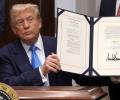
For India, the challenge is to strike a balance between tactical necessity and economic priorities, point out Pravin Krishna and Monil Sharma.

Seeking to give new impetus to the bilateral relations, India and Malaysia today formally announced firming up of Comprehensive Economic Cooperation Agreement (CECA) to boost trade and decided on a range of other engagements in various sectors, including defence.
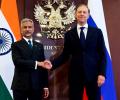
External Affairs Minister S Jaishankar has called for India and Russia to adopt a creative and innovative approach to address complex geopolitical challenges, emphasizing diversification and expansion of cooperation.

India's trade with China will touch the 100-billion dollar mark in the next five years, coming close to bilateral trade target with the European Union by 2013.

Alliances fight wars effectively only when they share an endgame. If Israel acted without US knowledge, then the military alliance is operating without real coordination at the level of strategic targeting. Neither picture is reassuring in a war that is no longer regional in its consequences. Prem Panicker continues his must read daily blog on the Gulf War.
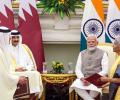
India and Qatar on Tuesday agreed to elevate their relationship to a strategic partnership and double bilateral trade to USD 28 billion over the next five years. Prime Minister Narendra Modi and Qatari Amir Sheikh Tamim Bin Hamad Al-Thani signed agreements and MoUs to strengthen economic cooperation, including a revised double taxation avoidance agreement. The strategic partnership will cover the "entire spectrum" of the bilateral relationship, including trade, energy security, and regional and international cooperation. Both leaders also discussed ways to further strengthen and broaden the energy partnership, including "exploring mutual investments." The Amir's visit provided an "excellent opportunity" for the top leadership of the two countries to discuss and "cement a strategic partnership for enhanced future cooperation."

In 2011-12, the bilateral trade between the two countries stood at $75.45 billion.
